Tubing inspection from the tube OD
Inspection of small-diameter tubing from the OD using a claw-type MsT probe
A claw-type magnetostrictive (MsT) probe couples to the outside diameter (OD) of small-diameter tubing for guided-wave inspection. Before coupling the probe, dust and scale are brushed from the tube surface, then a thin layer of shear-wave couplant is applied to the probe for reliable acoustic coupling. Mounted on an extended arm, the probe enables inspection of tubes up to the sixth row in superheaters.
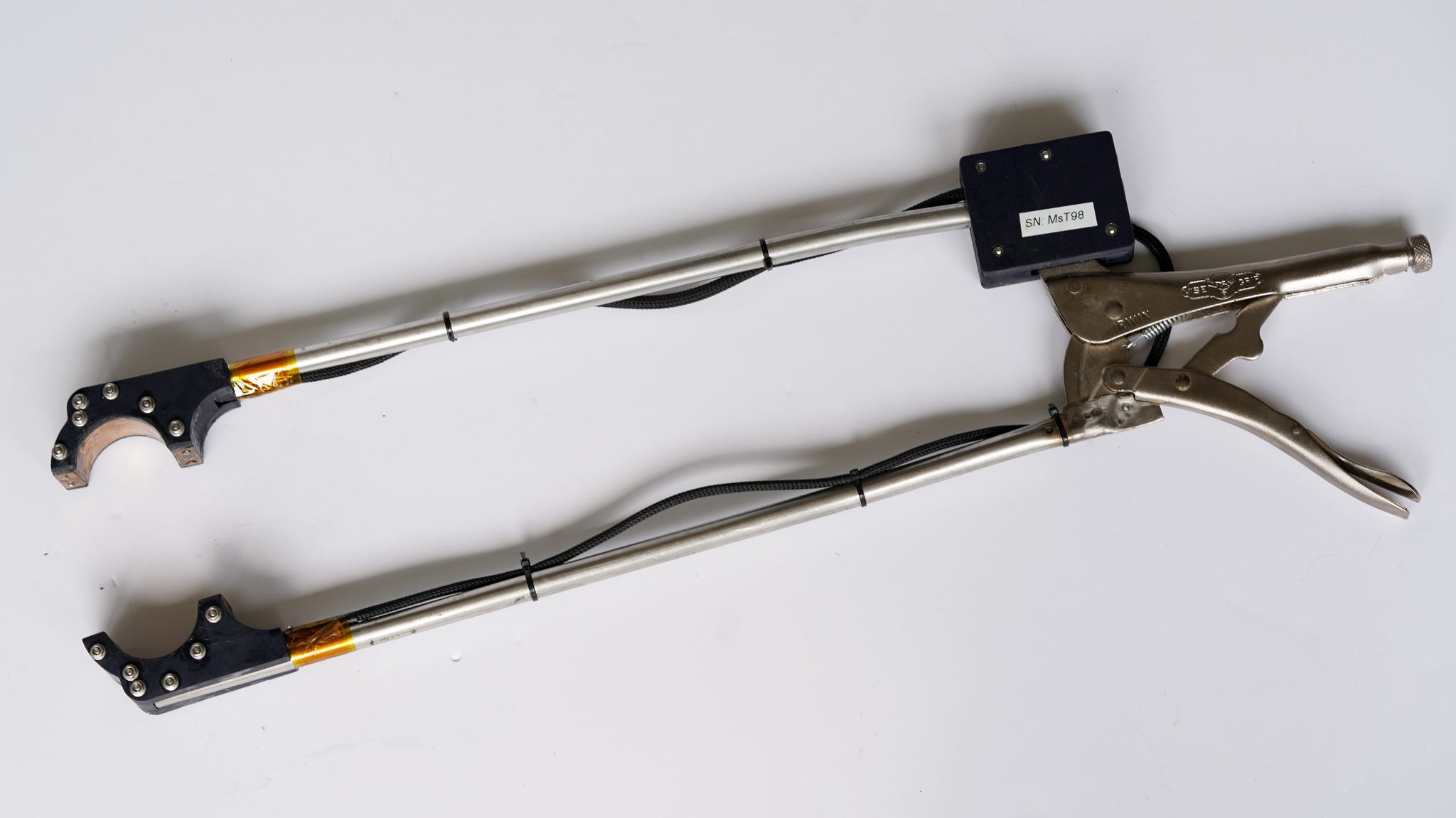
Probe for coupling to the outside diameter of small-diameter tubing.
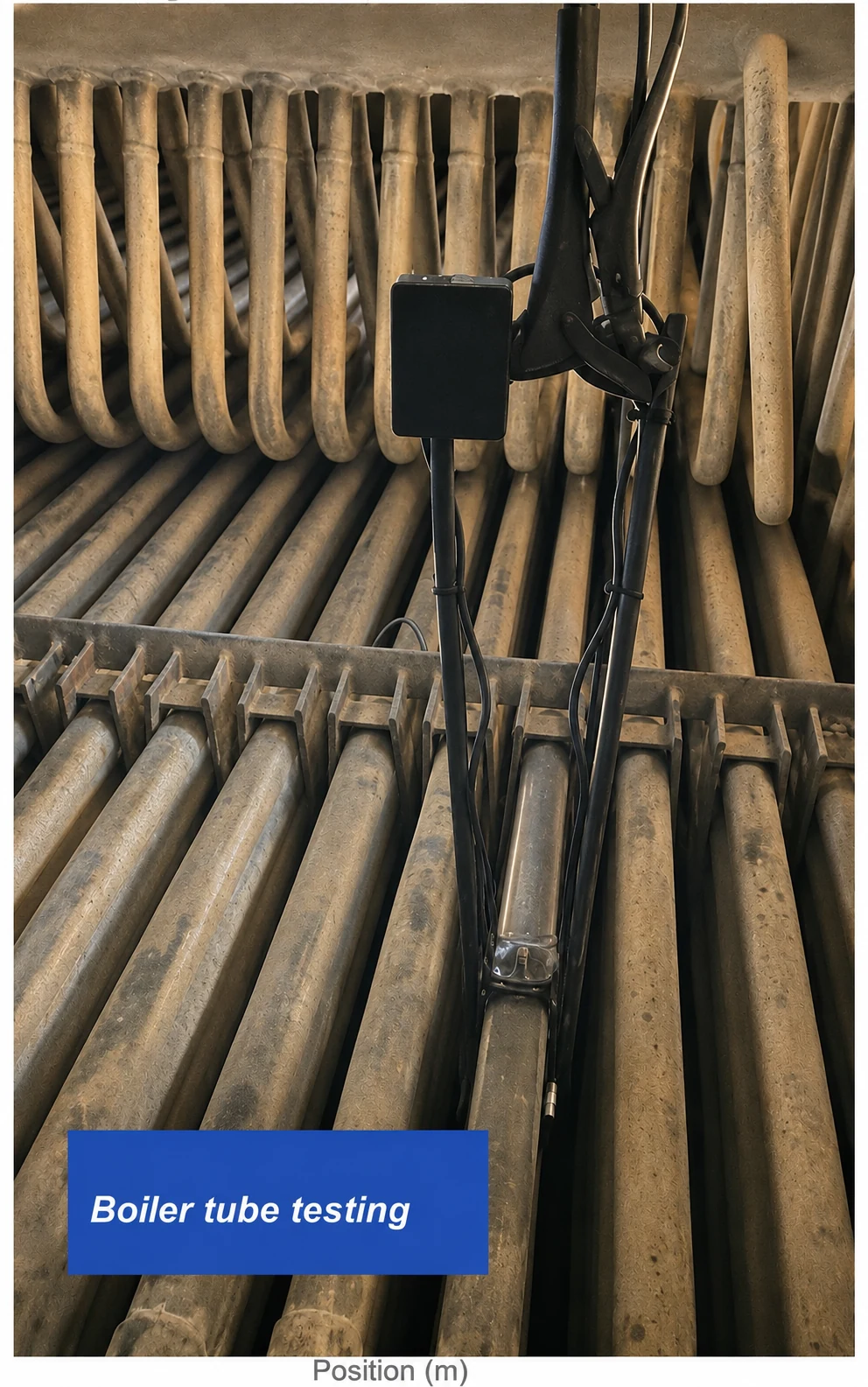
Photo retouched to remove glare and red markings. View original photo.
Published reference: Sergey Vinogradov and Jay Fisher. Review of Guided Wave Testing Using Magnetostrictive Transducers. ECNDT 2018. Open paper — page 7, “GWT of boiler tubes”.
Presentation reference: ICENDE 2023 keynote, slide 22 — MsT for GWT of Boiler Tubes.
Related application: one-sided access
Modified MsT probe configurations can enable guided-wave inspection of boiler tubes with access from only one side. A partial-coverage probe couples to the accessible side of the tube. The EPRI report below describes a related waterwall-specific configuration for detecting cold-side anomalies from the hot side.
EPRI report 3002008555: Use of Ultrasonic Guided Waves for Detection of Wall Loss and Cracking in Boiler Membrane Water Wall Boiler Tubes: Detection of Damage in Water Wall Boiler Tubes from the Hot Side. Technical Update, December 21, 2016, 50 pages. Read public abstract. Full report requires EPRI access or purchase.
Multi-frequency guided-wave inspection of boiler tubes
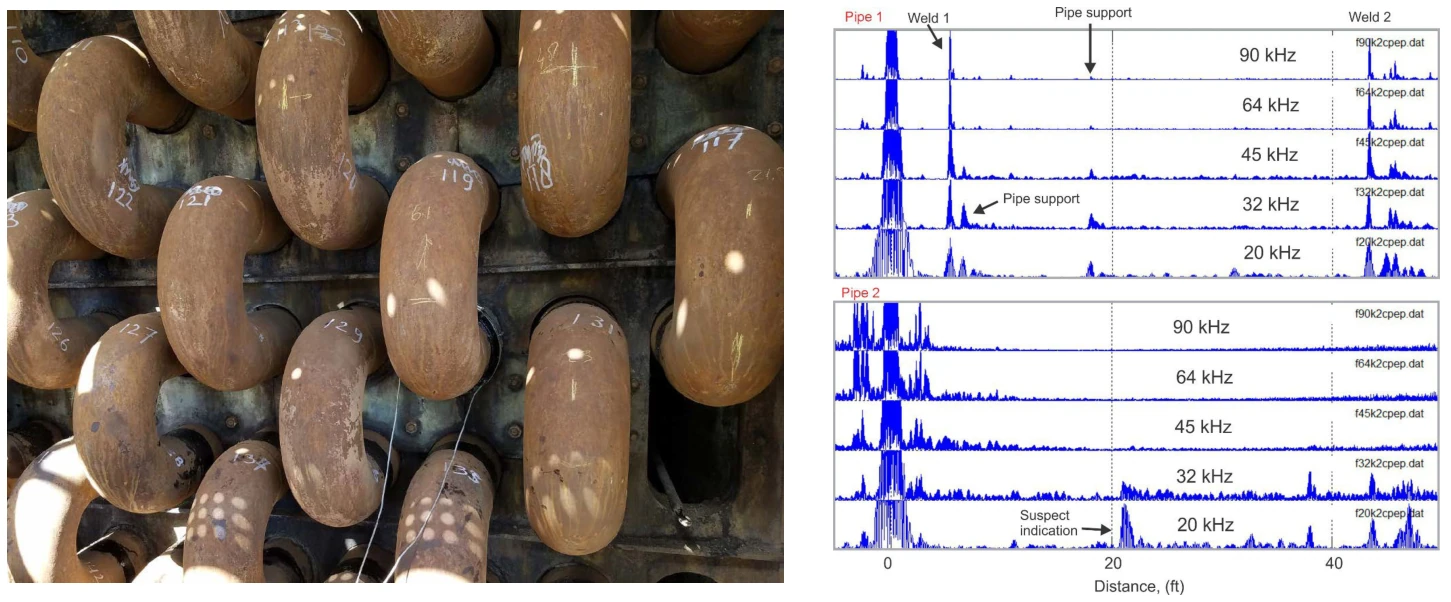
With the magnetostrictive transducer (MsT) in place, guided-wave measurements were collected from two boiler tubes without changing coil adaptors. The figure shows a set of measurements at 20, 32, 45, 64, and 90 kHz.
Related probe: OD-coupled tubing inspection with a claw-type MsT probe.
Results
Pipe 1. Reflections from two welds and a pipe support provide reference points for comparing the traces at different frequencies.
Pipe 2. A suspect indication appears at about 20 ft (6 m) from the probe. It is most apparent in the 20 kHz trace. Its cause and dimensions were not established.
Why multiple frequencies matter
Lower frequencies (20–50 kHz) are useful for screening for generalized corrosion. Higher frequencies (60–90 kHz) can help detect localized pitting and examine regions beneath pipe supports. The presentation also identifies 180–250 kHz for these applications. Comparing measurements from the same probe position shows which indications are most apparent at each frequency.
Slide reference
Sergey Vinogradov. Magnetostrictive Transducers for Guided Wave Testing and SHM of Pipes, Tank Walls, Tank Bottoms, Steel Ropes, Buried Anchor Rods and Heat Exchanger Tubing. Keynote lecture, Pune, India, August 25, 2023.
ICENDE 2023, slide 15 shows the tube bends and both sets of A-scans.