Magnetostrictive guided-wave technology uses low-frequency ultrasonic guided waves to inspect areas that are difficult or impossible to access directly from a remote sensor location. The waves are guided by the boundaries of the inspected structure and can propagate over long distances with relatively low attenuation, allowing large areas of pipes, plates, tanks, and other structures to be screened from a limited number of sensor positions.
Magnetostrictive transducers can generate both longitudinal (compressional) and torsional or shear-horizontal guided-wave modes. For pipe and plate inspection, torsional and shear-horizontal modes are often preferred because their fundamental modes can be essentially non-dispersive over the frequency range of interest, simplifying interpretation over long propagation distances. Longitudinal guided waves are useful for structures such as wire ropes and cables, where geometry and construction can make torsional or shear-horizontal excitation less practical.
GNDE develops magnetostrictive transducers for generating and receiving these guided waves. Magnetic-field orientation controls the type of dynamic strain, while FeCo materials, excitation windings, and bias magnets determine the sensor configuration and efficiency.
Magnetostrictive guided-wave technology overview
Wiedemann and reversed Wiedemann effects
Magnetostrictive guided-wave excitation uses the interaction of static and time-varying magnetic fields to produce alternating shear strain. In the conventional Wiedemann effect, a static circumferential bias field interacts with a time-varying axial field. The reversed Wiedemann effect exchanges these orientations: an axial static bias interacts with a time-varying circumferential field. The resulting shear strain can excite torsional guided waves in cylindrical structures or shear-horizontal guided waves in plates, depending on the configuration.
Reference for the physical principles and sensor configurations: Vinogradov, S., Cobb, A., and Fisher, J. (2018). New Magnetostrictive Transducer Designs for Emerging Application Areas of NDE.Materials, 11(5), 755. See Figure 1 for direct versus reversed field orientations, and Figures 2–3 for the corresponding transducer designs. Read the open-access Materials paper ↗
Guided-wave generation using a magnetostrictive FeCo transducer. The animation illustrates excitation of the sensor and guided waves propagating outward from the transducer location.
FeCo sensor construction and magnetic excitation
A magnetostrictive sensor combines a thin iron-cobalt (FeCo) strip, excitation windings that produce a time-varying magnetic field, and permanent magnets providing the static bias. This construction transfers magnetostrictive strain into the inspected structure to launch and receive guided waves.
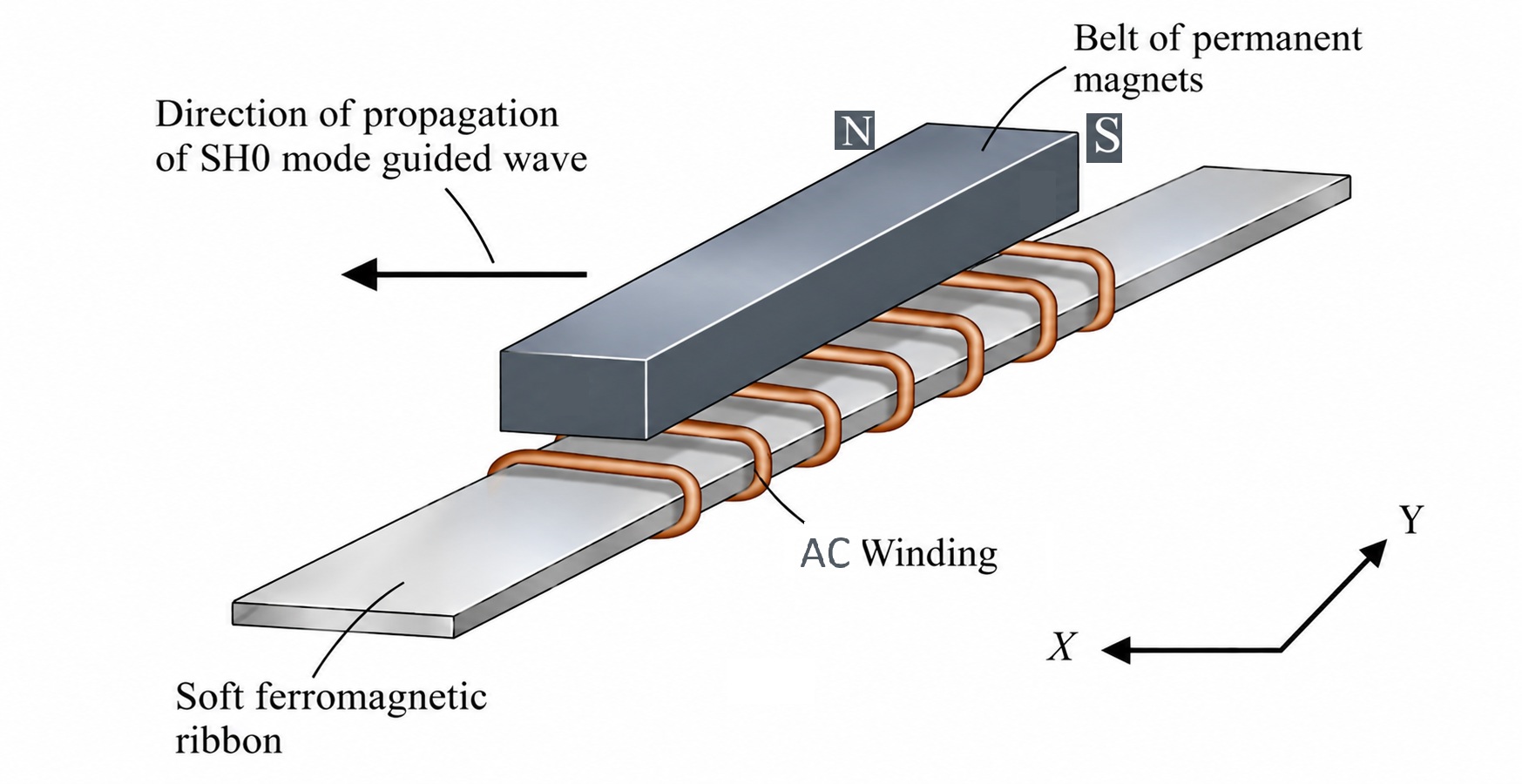
The reversed-Wiedemann-effect sensor design illustrated on the left uses double-sided excitation. A solenoid-type excitation winding surrounds the FeCo strip and produces a time-varying magnetic field through the strip thickness, providing excitation on both sides. The winding arrangement allows high magnetic-field strengths to be achieved in the FeCo material. The plot on the right compares root-mean-square (RMS) strain—the effective magnitude of the alternating strain, expressed in microstrain (µε; 1 µε = 10−6 strain). For the calculated conditions at 30, 60, 90, and 120 kHz, double-sided excitation produces approximately 3.2–4.6 times the mid-plane RMS strain obtained with a one-sided excitation configuration. These calculations assume the same winding turn density for both the one-sided and double-sided excitation sensor designs.
FeCo ribbon sensor with AC winding and permanent magnet bias, illustrating SH0 guided-wave propagation.
Calculated FeCo mid-plane microstrain at 30, 60, 90, and 120 kHz for one-sided and two-sided coil excitation. Website redraw based on Figure 3b of Vinogradov et al. (2026); see the original article for the published figure.
Source for probe construction, strain comparison, and SNR/mode assessment: Vinogradov, S., Akimov, N., Cobb, A., and Fisher, J. (2026). Screening of Corrosion in Storage Tank Walls and Bottoms Using an Array of Guided Wave Magnetostrictive Transducers.Sensors, 26(4), 1253, Figures 3b and 9 (strain comparison and plate-mockup results). Read paper and Figure 3 ↗
Testing of the reversed-Wiedemann-effect magnetostrictive sensor array on a plate mockup demonstrated a signal-to-noise ratio (SNR) of 53.9 dB for the reflection from the plate end, measured relative to background noise. The tests also demonstrated good SH0 mode selectivity: unwanted indications associated with the S0 compressional mode and mode conversion were approximately 3% of the plate-end reflection amplitude. This 3% figure describes the relative amplitude of unwanted indications, not the fraction of energy generated in other modes. Results and test conditions are reported in the cited paper.
The reversed-Wiedemann-effect sensor can be manufactured with a profile as low as 1 mm and offers a highly flexible construction. Sensors can be fabricated in segments and assembled into arrays tailored for either nondestructive inspection or permanent structural health monitoring.
High-temperature FeCo performance
Experimental studies of Hiperco 50 HS FeCo strips demonstrated guided-wave transduction at temperatures up to 800°C (1,472°F), with signal-amplitude variation on the order of 6 dB. Temperatures below approximately 700°C (1,292°F) were identified as more suitable for this material because of recrystallization considerations.
The temperature capability of the FeCo material is not an operating-temperature rating for a complete transducer. Coils, insulation, bias magnets, and mechanical attachment must be qualified separately.
For permanently installed structural health monitoring applications, FeCo magnetostrictive probes are currently most suitable for operating temperatures up to approximately 300°C (572°F). Custom sensor configurations for higher-temperature applications are available upon request, subject to application-specific design and qualification.
Reference: Vinogradov, S., Cobb, A., and Fisher, J. (2019). Evaluation of FeCo Magnetostrictive Sensors for SHM of Components Operating in Harsh Environmental Conditions. 46th Annual Review of Progress in Quantitative Nondestructive Evaluation, QNDE2019-1234. Read conference paper (PDF) ↗
The high-temperature experimental response plot will be added when the publication-quality figure is available.
Corrosion Mapping Using Array Magnetostrictive Sensors
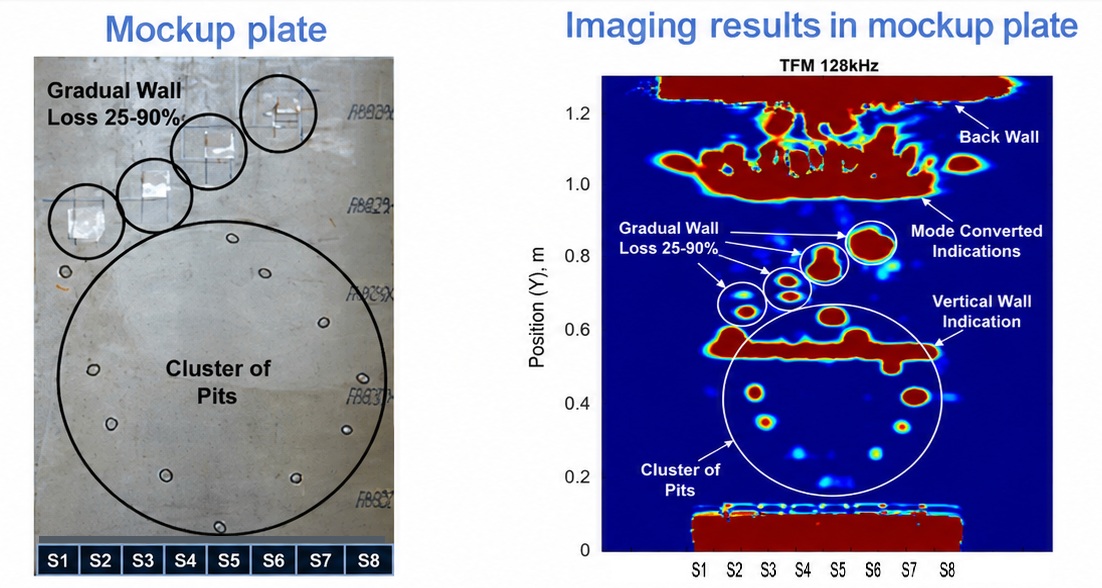
Magnetostrictive sensing elements can be combined into an array for guided-wave inspection and defect mapping. In the example below, an 8 × 8 probe array was used to inspect a mockup plate containing drilled holes, localized wall loss, and clusters of pits. Full matrix capture and total focusing method (FMC/TFM) processing produced a spatial map of the indications.
High-resolution defect mapping in a mockup plate: 8 × 8 array arrangement (left) and FMC/TFM imaging result (right).
The corrosion map provides an overview of the general corrosion pattern across the inspected component. Detailed evaluation of individual indications typically uses both B-scan and Total Focusing Method (TFM) images. The B-scan provides more reliable amplitude information for assessing the relative strength of indications, while TFM offers improved spatial localization and a more detailed representation of the corrosion distribution and morphology. Together, these complementary views support a more comprehensive interpretation of corrosion damage.
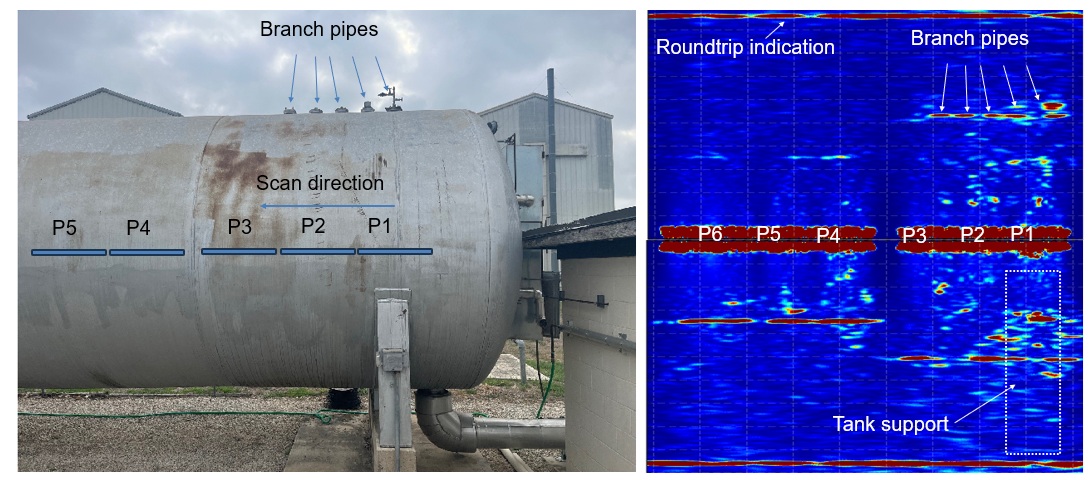
Magnetostrictive sensor arrays can be readily repositioned from one inspection location to another, making incremental scanning of large structures feasible. At each position, the array generates a local corrosion map. The software supports merging maps acquired at adjacent, overlapping locations into a larger composite map, providing a more continuous view of corrosion distribution across the component.
Corrosion mapping using array magnetostrictive sensors on a large vessel.
Scientific foundation
Published theory and experimental evidence
GNDE's technology builds on decades of research in magnetostriction, electromagnetic shear-wave generation and ultrasonic guided waves. Selected supporting papers:
Advanced MsT sensor designs
Vinogradov, Cobb and Fisher (2018). New Magnetostrictive Transducer Designs for Emerging Application Areas of NDE. Materials 11(5), 755.
Vinogradov et al. (2026). Screening of Corrosion in Storage Tank Walls and Bottoms Using an Array of Guided Wave Magnetostrictive Transducers. Sensors 26(4), 1253.