Guided-Wave Testing of Buried Anchor Rods Using Magnetostrictive Transducers
Case study based on the supplied slide titled “GWT of Buried Anchors using MsTs.” A magnetostrictive transducer (MsT) is installed on the accessible section of a rod to send guided waves toward its buried end and record reflections from changes along the structure.
Buried anchor inspection: two field measurements
The clamp-on probe was mounted on the exposed portion of each 2-inch (51 mm) anchor rod. The slide shows the installation and the traces from two rods with concrete attachments near their buried ends.
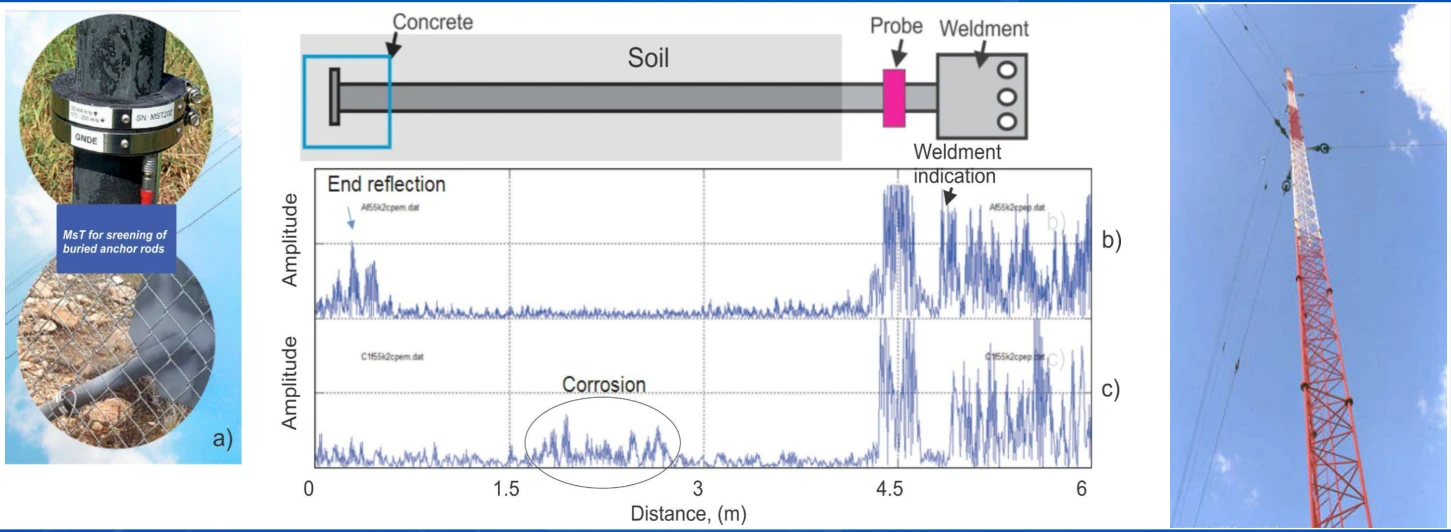
Comparison of inspection results
- Anchor (b): A clear bottom/end reflection was observed, and no other relevant indications were identified.
- Anchor (c): The end reflection was absent, and multiple indications appeared in the middle section. The slide states that the condition was visually identified as a sharp bend; the displayed indications are marked as a corrosion region.
Interpretation and limitations
The technique provides a qualitative indication of rod condition. The slide proposes ranking anchors into good, medium, and bad condition categories. The measurements shown do not establish a numerical percentage of corrosion wall loss or a quantitative remaining-strength assessment.