Elevated-Temperature Pipe Monitoring
A BP-supported pipe monitoring test at 200 °C and FeCo sensor research for pipes operating up to 500 °C.
BP case study · Structural health monitoring of pressurized pipe at 200 °C
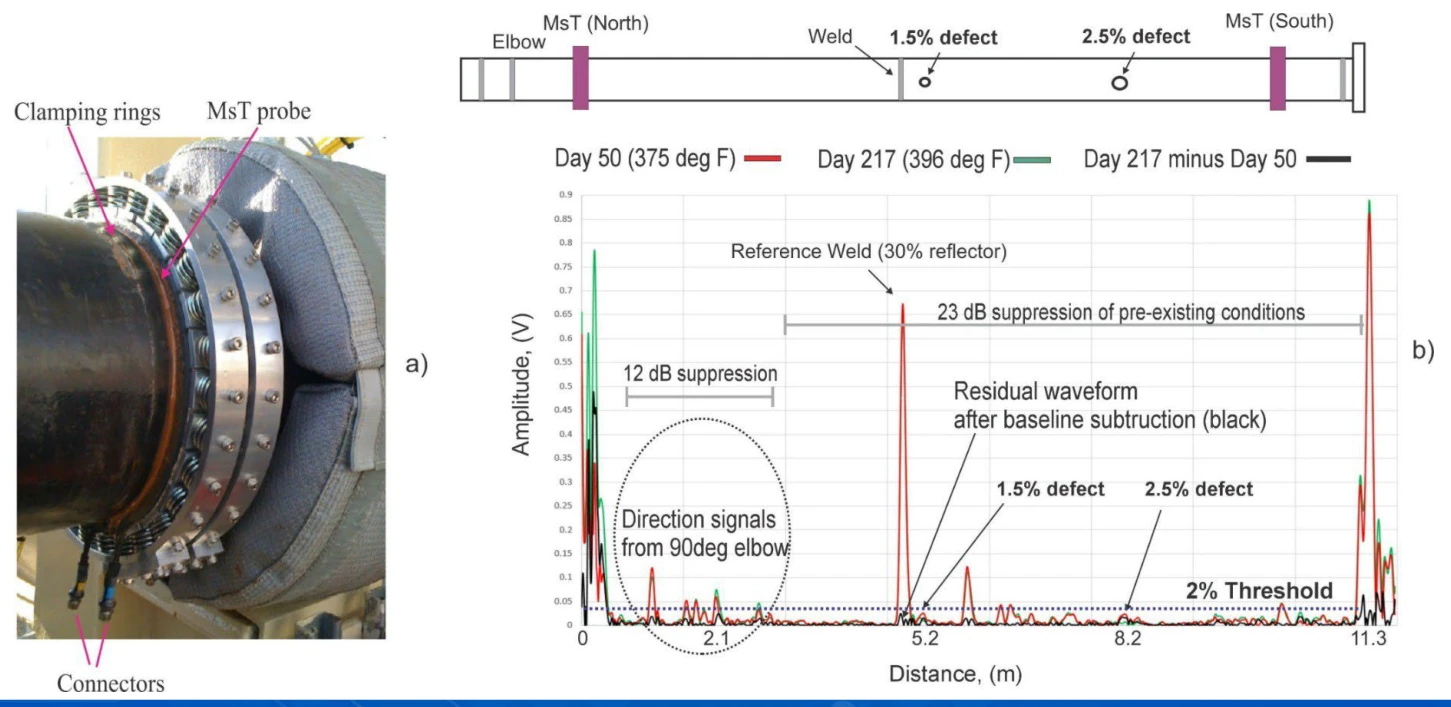
Researchers monitored a 219 mm OD Schedule 40 pipe mockup through 270 days of thermal cycling with a target operating temperature of 200 °C. Figure 5 compares the guided-wave A-scans recorded on day 50 at 190 °C and day 217 at 202 °C.
NDT.net and ASME references for the BP test
Sergey Vinogradov and Jay Fisher. Review of Guided Wave Testing Using Magnetostrictive Transducers. 12th European Conference on Non-Destructive Testing (ECNDT), Gothenburg, Sweden, 2018, pp. 4–5.
Sensor research for pipe monitoring up to 500 °C
Vinogradov, Cobb, and Fisher measured how temperature affected the ability of an iron-cobalt (FeCo) patch to transmit and receive guided waves on a stainless-steel strip in a furnace. Page 1 identifies pipe monitoring at 500 °C as the intended application. Figure 2 on page 2 shows how signal amplitude changed during heating and cooling.
Sergey Vinogradov, Adam Cobb, and Jay Fisher. Evaluation of FeCo Magnetostrictive Sensors for SHM of Components Operating in Harsh Environmental Conditions. 46th Annual Review of Progress in Quantitative Nondestructive Evaluation, 2019.
ICENDE 2023 presentation
Sergey Vinogradov. Magnetostrictive Transducers for Guided Wave Testing and SHM of Pipes, Tank Walls, Tank Bottoms, Steel Ropes, Buried Anchor Rods and Heat Exchanger Tubing. Keynote lecture, Pune, India, August 25, 2023.
More references on high-temperature pipe monitoring
- Sergey Vinogradov, Charles Duffer, and Glenn Light. Magnetostrictive Sensing Probes for Guided Wave Testing of High Temperature Pipes. Materials Evaluation, vol. 72, no. 6, June 2014, pp. 803–811. Read the public abstract.
- Sergey Vinogradov, Thomas Eason, and Mark Lozev. Evaluation of Magnetostrictive Transducers for Guided Wave Monitoring of Pressurized Pipe at 200 °C. ASME Journal of Pressure Vessel Technology, vol. 140, no. 2, 2018, article 021603. Read the public abstract of the BP study · Publisher record.